




For MILPOST, we migrated the website from a website builder to Grav, added the admin panel and continued developing the service pages, navigation and calculator. This case study covers the content we preserved, the fields that became editable through the CMS and how we verified the published result.
Project website: MILPOST
Initial task
The company already had a public page with a description of customs services, documents, announcements and contacts. When moving, it was necessary to save these materials and links, and transfer content management to the CMS.
At the first stage, we transferred the existing page. The development of the calculator and forms took place in subsequent releases, so we describe the results of these stages separately.
Work and documented results
| Work | Result | Period or source |
|---|---|---|
| CMS migration and website improvements | Grav replaces the website builder | October 2026 |

CMS migration and website improvements
Grav replaces the website builder · October 2026
Migrated the site from a website builder to Grav and set up the admin panel. Improved the calculator, service pages and navigation. Website text and settings can be edited through the CMS.
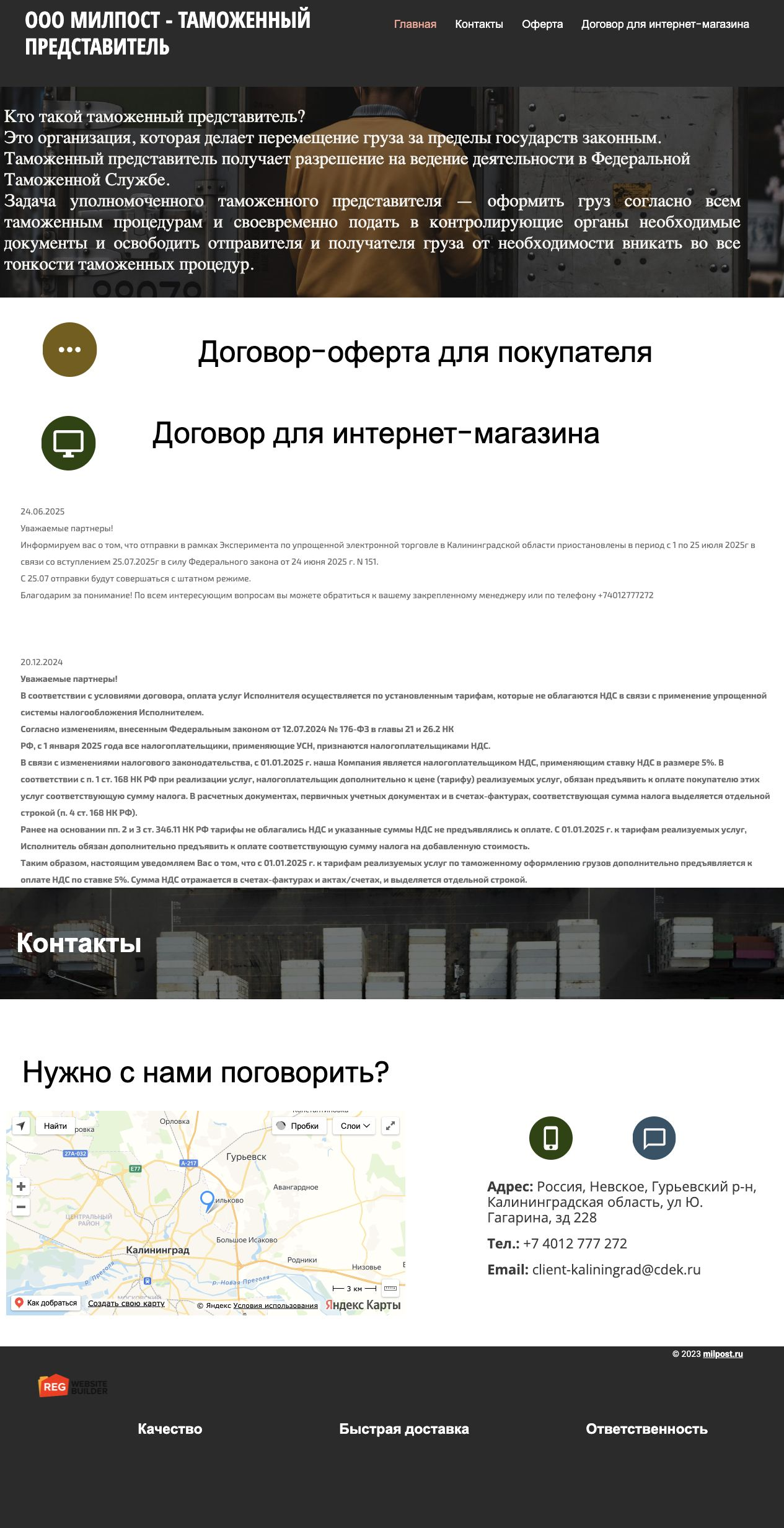
We installed Grav with the administrative interface and prepared the site theme. We moved the header, menu, images, announcements, contacts, map and footer. The links to the offer and the contract were retained, and the transitions to the relevant sections were corrected.
The texts and settings of the main page were transferred to structured CMS fields. Through the admin panel you can change the menu, first screen, documents, announcements, contacts, map and images. These edits do not require the user to edit the HTML.
After migration, we improved the service pages and calculator. It separates checking an indicative price from sending an enquiry to the manager. Contact details are required for an enquiry, while the available preliminary calculation can be viewed without them.
We added directory search and suggestions for route selection. Changing the town resets the previous selection and price. If a town is missing from the directory, the visitor can enter its name manually for the manager to review; that route does not receive an automatic price.
How we verified the result
The migration report for October 8, 2026 recorded HTTP 200 for the main page, CSS and image loading, mobile menu working at 390 px width and no horizontal overflow. Domain switching and HTTPS were checked separately.
For the calculator, the choice of route, changes in initial data, preliminary calculation and saving of the request were checked. In subsequent checks, tariffs and settings were compared before and after the change, so that editing the interface did not change the calculation rules.
The screenshots below show public pages. They illustrate the interface; verification of saving the enquiry and calculation rules is based on separate checks, and not on the image of the form.

Scope of the result
The result of the move is a managed website and saved content. Sales, traffic, or conversion growth was not measured in this case study.
The shipping price in the calculator depends on the published rules and the input data. A manually entered route or non-standard cargo requires the manager's review; the interface does not replace agreement on shipping terms.
What to consider for a similar project
Such a move is suitable when existing content needs to be preserved, and further edits need to be transferred to an employee through the CMS. Before starting, it’s worth separately listing the materials to be transferred, editable fields and new functions: these are different parts of the work.